

State Criminal Offences in NSW
0 CommentsA criminal case is a case where a prosecutor has charged a person with a crime or offence. The person who has been charged with the offence is the defendant or the accused. The Prosecutor may be a police officer, a prosecutor from the Office of the Director of Public Prosecutions (NSW) or from the Commonwealth Director of Public Prosecutions, or another government agency.
Most criminal cases in New South Wales first come before the Local Court. Juries are not used in the Local Court. For a criminal case to be proven, the standard of proof is beyond reasonable doubt. The types of criminal cases in New South Wales include summary offences and indictable offences, where indictable offences involve more serious offences. The Local Court generally hears summary matters, while the District Court and Supreme Court hear indictable matters. There are some indictable offences also known as table offences, which can be heard in the Local Court.
For indictable offences, they will start in the Local Court, and the defendant will be committed for hearing in the District or Supreme Court. If a defendant pleads guilty to the offence while it is in the Local Court, the case is committed for sentencing. If the defendant pleads not guilty, the case will have a committal hearing in the Local Court. The role of the judge in committal hearings is to determine whether the prosecution’s evidence is capable of satisfying a jury, beyond reasonable doubt, that the defendant has committed an indictable offence. If the judge is satisfied that the evidence is capable of satisfying a jury, the defendant is committed for trial or sentence to a higher court, either in the District Court or Supreme Court, depending on the particular offence. For cases committed to a higher court, they are generally then determined by a judge and jury.
The District Court of New South Wales deals with a wide range of criminal matters. However, charges that the District Court cannot hear include murder or treason, which must be dealt with by the Supreme Court. The District Court determines cases that have been committed or referred from the Local Court or Children’s Court. Cases are committed to the District Court for trial or for sentence.
A sentence hearing is held if a person pleads guilty to an indictable offence. Sentence hearings are heard by a judge, and juries do not determine sentence cases. The accused and the prosecution make submissions about the sentence. At sentence hearings, the court will be presented with the facts of the case and may order a pre-sentence report to be provided regarding the case. The prosecution and defence may present other appropriate reports and evidence; this can include previous criminal records or other statements.
Trials
A trial is held when the accused person pleads not guilty to an indictable offence. A jury will determine the guilt or innocence of the accused, unless a judge-alone trial is held.
The prosecution is responsible for proving beyond reasonable doubt that the accused person committed the alleged offence. The defence can cross-examine the prosecution witnesses, challenge the evidence or call evidence or witnesses. If an accused person who is on bail does not attend court, the judge can issue a warrant for their arrest, or the judge may order that the bail is forfeited.
Judge Alone Trial
An accused person or the prosecution can apply for the case to be tried by judge alone, instead of by jury. An application for trial by judge alone is made by notice of motion and must be made at least 28 days prior to the trial date, or with the leave of the court.
Criminal Trial by Jury
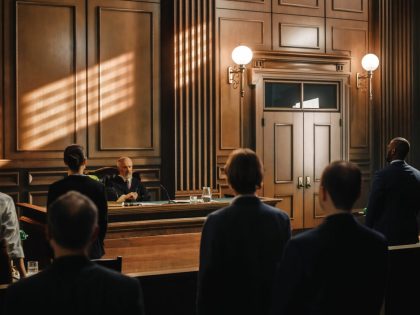
The following includes general steps in a criminal trial by jury:
- jurors are sworn in for jury service
- the offences are read out to the accused
- the accused takes a plea before the jury
- the Crown or the prosecutor and the defence open their respective cases
- the Crown calls witnesses, and the witnesses give evidence
- the defence calls witnesses, and the witnesses give evidence
- the Crown raises issues in reply to the defence’s case, and addresses the jury
- the defence addresses the jury
- the judge sums up, and the jury deliberates
- the jury returns and delivers a verdict, or advises that they are unable to reach a verdict
- if the accused is found to be guilty, the case is adjourned to another date for sentence
- if the accused is found to be not guilty, the accused is discharged
- if the jury is discharged without reaching a verdict or there is a hung jury, the matter is relisted for trial
In trials by jury, the jury can return a guilty or not guilty verdict. If the jury returns a not guilty verdict, the defendant is acquitted and discharged. If the jury returns a guilty verdict, the accused is convicted and may be sentenced.
The penalties the court can impose include fines, conditional release orders, community correction orders, intensive correction orders and imprisonment.
Judgments which include the reasoning for a sentencing decision by district court judges may be delivered orally or in a written form, and published judgments can be accessed online.
About Post Author

* Information contained in this article is of a general nature only and should not be relied upon as concise legal advice.
Please contact for legal advice tailored to your situation. *